
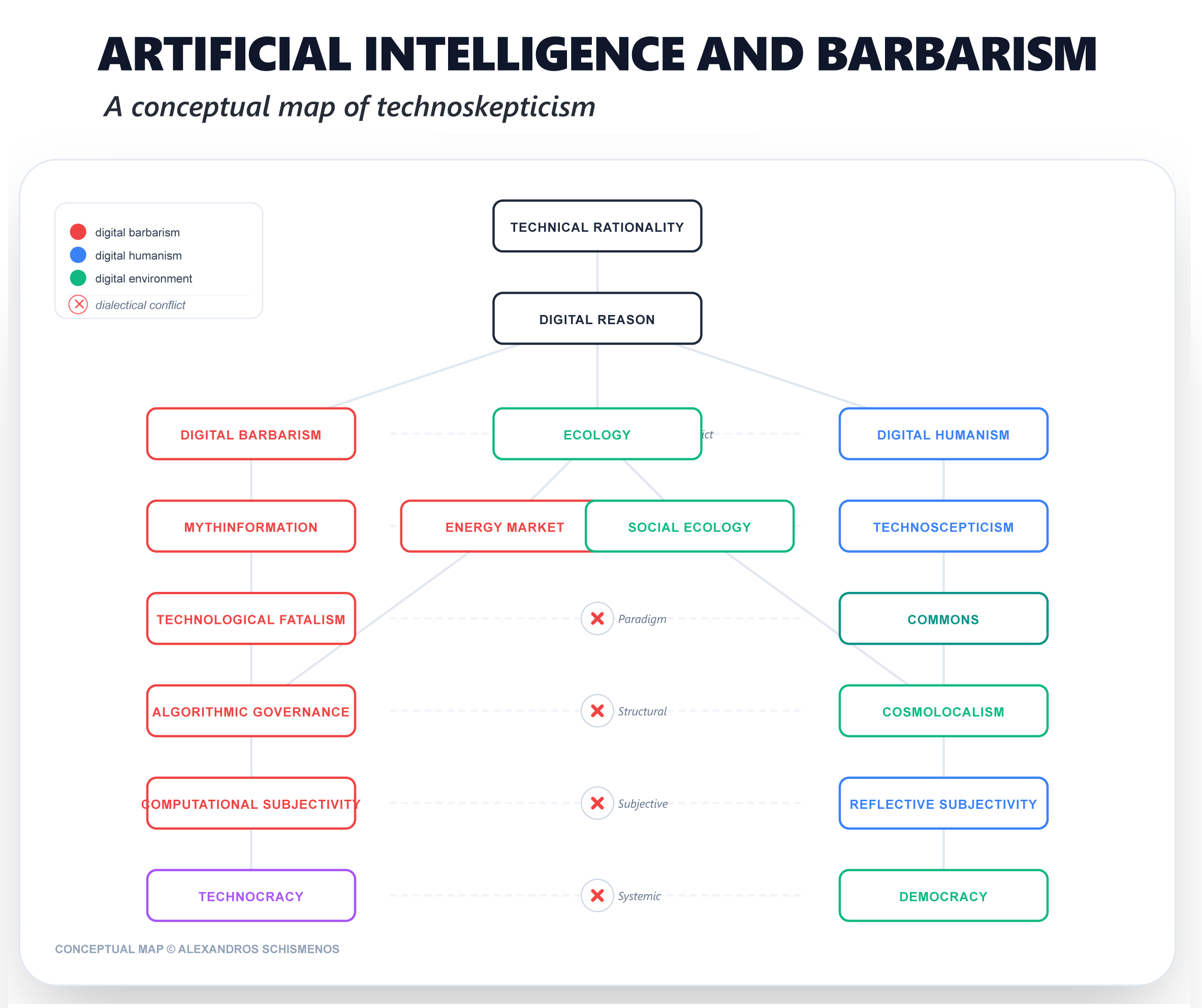
A structured mapping of “Artificial Intelligence and Barbarism“, tracing the dialectical paths between digital reason, algorithmic domination (Barbarism), and the potential for democratic, commons-based autonomy (Humanism).

2. Glossary of Terms
A.1 Structural Concepts
– Digital Reason: The computational mode of rationality that quantifies, predicts, optimizes, and classifies. It treats the world as a set of calculable operations and tends to universalize its own logic.
Emphasis: computational rationality, quantification as worldview.
– Crisis of Digital Reason: The moment when digital reason is mistaken for universal reason, producing epistemic overreach and political distortions.
Emphasis: epistemic crisis, limits of computation.
A.2 Digital Barbarism Path
– Digital Barbarism: A technologically advanced form of domination where algorithmic logic becomes a mode of social control.
– Mythinformation: The ideological belief that more information automatically produces better societies, masking structural inequalities.
– Technological Fatalism: The assumption that technological development is inevitable and beyond political intervention.
– Algorithmic Governance: The delegation of political, economic, and social decisions to automated systems.
– Computational Subjectivity: The shaping of human identity and behavior according to algorithmic norms and predictive models.
– Technocracy: The culmination of the Barbarism path: rule by experts, systems, and algorithms rather than democratic deliberation.
A.3 Ecological Bifurcation
– Ecology: A mediating and contested field between domination and emancipation. It can be captured by technocratic systems or aligned with democratic commons.
– Energy Market: The commodification of ecological systems, linking environmental policy to market logic and reinforcing the Barbarism path.
– Social Ecology: A democratic, community-based ecological philosophy emphasizing autonomy, cooperation, and local empowerment.
A.4 Digital Humanism Path
– Digital Humanism: A philosophical counter-position that restores human agency, judgment, and ethical responsibility in technological systems. It exists in two primary versions: a mainstream version that often distracts attention from power dynamics through surface-level ethics, and a democratic version that focuses on the power structures behind AI and ICT.
– Technoskepticism: Critical reflection on the limits, risks, and unintended consequences of digital systems.
– Commons: Shared resources governed collectively rather than through markets or states; the hinge between humanistic critique and ecological democracy.
– Reflective Subjectivity: A mode of selfhood grounded in critical awareness, autonomy, and resistance to algorithmic shaping.
– Cosmolocalism: A socio-technical alternative based on global knowledge sharing and local autonomy.
– Democracy: The political horizon of the Humanism path: participatory, ecological, and commons-oriented governance.
Expanded Glossary:
Digital Reason
Digital reason is the mode of rationality embodied in computational systems: quantifying, optimizing, predicting, and classifying. It privileges calculability over understanding and treats the world as a dataset to be processed. Digital reason becomes problematic when it is mistaken for universal reason — when society allows algorithmic inference to define what counts as knowledge, value, or truth. The crisis of digital reason is the crisis of a world governed by a narrow, instrumental logic masquerading as objectivity.
Digital Barbarism
Digital barbarism names the condition in which technologically advanced societies regress in their capacity for judgment, autonomy, and critical thought. It is not a return to precivilizational chaos, but a new form of domination produced by algorithmic rationality itself. Digital barbarism emerges when:
– decision-making becomes automated and opaque
– human experience is reduced to data
– efficiency replaces meaning as the dominant value
– social relations are reorganized around computational logics
It is the paradox of a civilization that becomes more technologically sophisticated while becoming ethically and politically impoverished.
Technoskepticism
Technoskepticism is a critical stance toward technology that rejects both naïve technophilia and reactionary technophobia. It insists that:
– technology is never neutral
– digital systems embody political and economic interests
– critique is necessary for democratic control of innovation
Technoskepticism is not fear of technology; it is the refusal to accept technological inevitability.
It restores political agency to technological development.
Mythinformation
Mythinformation is the ideology that equates the expansion of digital information with the expansion of truth, freedom, and social progress. It is the belief that more data produces more knowledge, more connectivity produces more democracy, and more information access produces more autonomy. Mythinformation transforms technological infrastructures into cultural myths. It conceals the power relations, biases, and economic interests embedded in digital systems, preventing critical reflection on the limits of information-centric thinking.
Algorithmic Governance
Algorithmic governance describes the delegation of social, economic, and political decisions to automated systems. It includes predictive policing, algorithmic credit scoring, automated hiring, content moderation, and behavioral nudging. This form of governance is characterized by opacity, asymmetry of power, and the displacement of public deliberation by technical procedures.
Cosmolocalism
A socio-technical and philosophical framework that combines global knowledge-sharing on the level of design, coding, and deliberation with local autonomy on the level of manufacturing and decision-making. Cosmolocalism envisions a world where:
– knowledge, software, and design are shared openly across global networks
– communities adapt and produce what they need locally
– technological development is cooperative rather than extractive
– digital infrastructures support commons-based production
As an alternative to digital barbarism, cosmolocalism proposes a distributed, commons-oriented model of technological creation grounded in solidarity, democratic self-governance and local empowerment.
Humanism and Subjectivity
Digital Humanism (Radical)
Digital humanism, in its mainstream form, seeks to “humanize” technology without challenging the structures that produce technological domination. It often becomes a moral veneer for corporate AI, a personalization of systemic problems, or an ethical branding exercise.
Our critique advocates for a democratic digital humanism that entails:
– a political critique of techno-capitalist networks
– a democratization of the control of digital information flows
– a social regulation of AI technology
– a deepening of the radical political project of social autonomy
– a recreation of free public time and space
– a re-evaluation of the individual as a citizen rather than a user.
Computational Subjectivity
Computational subjectivity refers to the internalization of algorithmic norms by individuals. People begin to think, act, and perceive themselves through the logic of digital systems. Examples include optimizing one’s life like a dataset, measuring self-worth through metrics, and adopting algorithmic categories as personal identities. It is the psychological dimension of digital barbarism — the point where external systems become internalized habits.
Technological Fatalism
Technological fatalism is the belief that technological development is inevitable, unstoppable, and beyond political control (e.g., “AI will replace jobs whether we like it or not”). This fatalism disarms democratic agency and legitimizes the expansion of digital reason.
